
HelloFresh: It's Not Good Value
In this article I discuss the claim that HelloFresh is good value. This article is the 1st of a four part series on HelloFresh where I present counter-arguments to popular claims about its merits.

Hi Readers: Apologies for not publishing anything over the last few weeks. I started this article 5 weeks ago with the intention of it being one big piece - and it ran away on me - so I have decided to break it up into themes. This 1st installment is about the claim that it offers great value; the next will be about how convenient it is; then I will discuss the argument that it offers excellent food quality and variety; and then finally, I will discuss the claim that HelloFresh is a great way to learn cooking skills.
I recently saw an ad for “HelloFresh” that spoke to all its merits - and I have to say - none of it resonated with me. I have co-workers, neighbors and friends that think it’s great. The internet tells me it’s great. My television tells me it’s great. It seems like everyone is on board, and I’m just missing the boat. So I thought I would share my take on all of the typical arguments in favor of this popular new dinner option. If you really like HelloFresh and think it’s great - maybe skip this article. If you are considering it - please read on. In this first article of my four-part series on HelloFresh, I address the claim that HelloFresh offers good value.

Value
Many people make the argument that HelloFresh is a good deal. So I went to the website to see what it would cost to buy meals for my family. I asked for five meals a week for a family of four. Here is what I was offered:
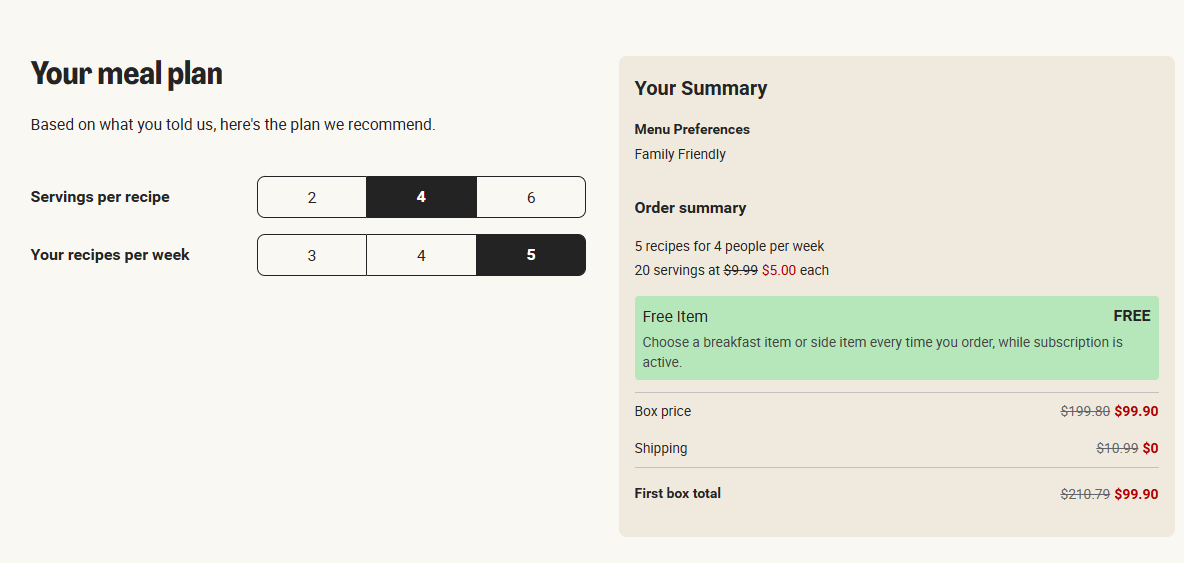
You can see in the image above, the costs have been cut in half, and the shipping has been cut to zero - such that the price of $210.79 is reduced to $99.90. The website tells me I will get $302 off my 1st 10 boxes, and so that’s why this week’s meals will be $99.90. Sounds good for this week, and next week, but it appears that after that, the prices will double, and I will be paying $210.79 a week for five meals. This is a problem since my current weekly family budget for food is $250 per week, and there’s still all our breakfast and lunch meals to be procured - and by the way - there’s seven days in a week - so I still need to get dinner meals for the other two days. We would clearly go broke if all our meals were procured in this way. To put that another way, this option asks that I burn through 84% ($201.79/$250)of my weekly food budget, to make 24% of my weekly meals (5/21) -and that’s not even counting snacks and desserts and stuff - which are also covered by my weekly budget.
I was initially going to employ a spreadsheet to confirm the argument that in the aggregate, over time, HelloFresh is simply not a sustainable choice in terms of cost. I can do that in a subsequent article if there is sufficient demand, but I think it should be obvious to anyone already that this gets expensive over time. $210 a week over 52 weeks is almost $11K a year - and that will only cover 24% of your dietary needs. There is simply no way that having individual meals delivered in a box to your door can be cost effective in the aggregate over time.
Now, with the issue of cost behind us, the main arguments from fans for value tend to go as follows:
It can be cheaper than frequent takeout or dining out.
The fact that it is cheaper than eating out or takeout does not mean it offers good value, it only means that, as a value proposition, it is not as bad a decision as those other bad decisions - it does not mean it is a good decision. Let’s look at this type of reasoning another way: Is hitting your head with a frying pan good for your health because it’s better that hitting your head with a hammer or an anvil? Of course not. Less bad does not mean good, and it does not mean optimal if there are better options.
It helps reduce impulse grocery spending because you buy only what you need.
Insofar as it might help to reduce impulse grocery spending (the urge some people have to throw everything they see into their cart when shopping), it would only do this if, by virtue of using HelloFresh , the person never went to a grocery store. Since most plans are for just a few meals - then the person still needs to be in a grocery store at least once a week, and will still run the risk of impulse shopping. I think making a list prior to going to the store and sticking to it is a much more practical and cost effective way to break such a habit.
Pre-portioned ingredients mean less food waste, which saves money.
This argument only holds if food waste is assumed. There are many ways to prevent food waste in a home. Buying smart is one of them, planning things out a little is another, and knowing a few dishes that will use everything up (e.g. soup/stew/etc.)1 also works - just to name a few. The notion that you need pre-portioned meals delivered to your door to reduce waste is preposterous. In fact, every one of those meals will have a delivery cost in addition to the value of the food items, so it will be like dumping a gallon of gasoline down the drain. In effect, one is simply trading food waste for fuel waste - and why - to avoid losing a few leaves of wilted lettuce (perfectly fine in soup) or a banana getting overripe (…did somebody say banana bread)? In effect, paying for HelloFresh to avoid generating food waste is more like a tax on the inability to do home economics.
Final Thoughts
I am old enough to recall a time when water was free. Now we pay more for it than gasoline. Is it really worth that much? Where did the drinking fountains go? Why do we need water all the time. What happened?
Value is a funny thing. In principle, determining value should be a cold, rational and analytical exercise - but in reality, we tend to have a hard time thinking about value in a manner that is divorced from our deeper desires. Unfortunately, due to the suggestive nature of modern marketing, many of our deep desires are not always innate; rather, they tend to be induced. Sometimes this occurs in an instant, by the triggering of a passion or some warm feeling of familiarity - but more often this happens gradually, over time, by means of many subtle suggestions and nudges. Sometimes those suggestions are also cleverly aligned with a broader zeitgeist - which seems to fortify and substantiate their apparent claim to truth. Eventually, we start wanting something so bad that we start seeing value where it does not exist.
I don’t think HelloFresh is good value. Do you? Please share your feelings in the comments section.
FREE SHIPPING FROM VESEYS SEEDS
Use my COUPON CODE “GAVS25” to get free shipping from Veseys Seeds on seed catalogue orders. Free shipping is not applicable on surcharges on larger items. Promo code is valid until November 30, 2025.
We often make “fridge soup”. It just means taking out everything that’s at risk of going bad, and finding a way to use it. There are hundreds of types of soup from all over the world, and with the internet, they can all be learned easily- so this option never gets boring.